
Project River: Both Sides of Bradley County's $11.3 Billion Project

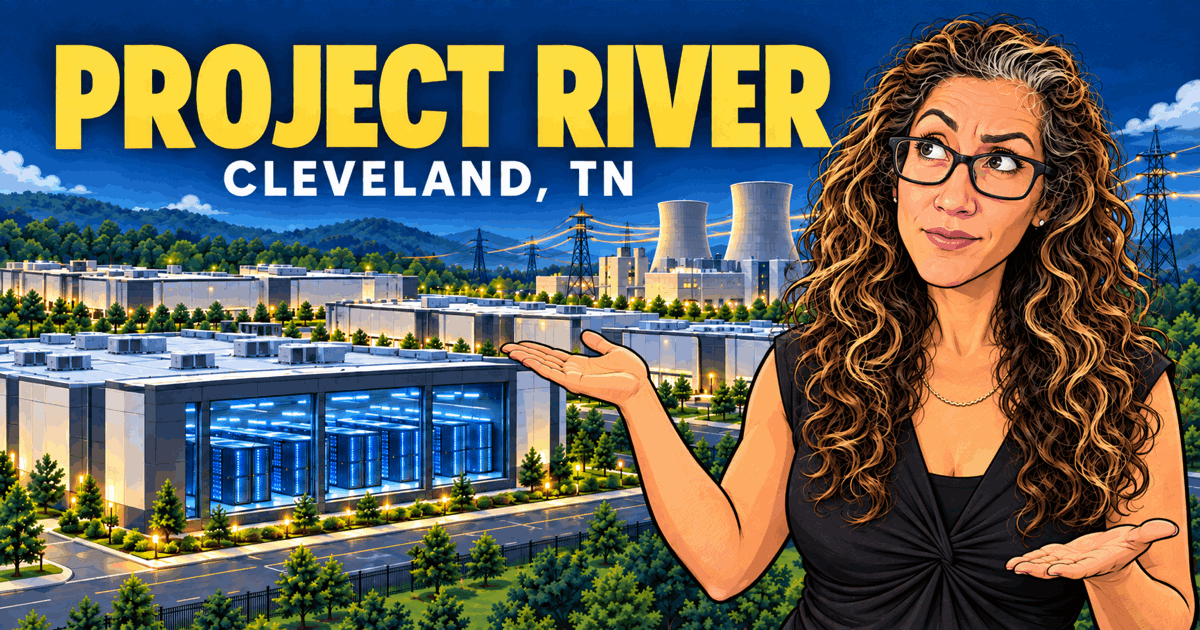
There's an $11.3 billion project on the table twenty minutes from Cleveland, and depending which article you read, it's either the biggest economic opportunity in Bradley County's history or an environmental problem in the making. Nobody's actually laid out both cases side by side. So here it is.
What Project River actually is
Project River is a proposed development on Lower River Road, just west of Cleveland, from the Wright family through their company, Wright Brothers Construction. It's worth understanding as two separate projects stacked together, because most coverage blurs them into one.
The first is a power plant — 1,500 megawatts total, made up of a 1,000-megawatt natural gas plant, a 500-megawatt biomass plant, and a 360-megawatt connection into the TVA grid. The developers describe this part as committed.
The second is the data center — the part making headlines. This part is not locked in. Wright Brothers Construction's own president has said the company doesn't yet have a confirmed "off-taker" for that power — meaning no signed tenant. That power could end up going to a data center, a manufacturer, or a semiconductor plant. Nobody's committed to a data center specifically. Yet.
That distinction matters for reading everything else about this story.
The case for it
The developer's own numbers: 250 jobs in power generation, 525 at the data center, and 125 in biomass handling — 900 permanent, direct, on-site jobs. On top of that, they're projecting roughly 1,700 indirect jobs regionally, mostly in forestry. Add those together and you land close to the 2,600 figure you may have seen quoted elsewhere — that's not a separate, conflicting number, it's the direct-plus-indirect total. During construction, they're projecting up to 3,500 workers on-site at peak.
The forestry number is worth sitting with. This region has real families who lost logging and paper-mill work in recent years, and the developers are specifically framing this project as a way to bring some of that work back.
On revenue: proponents say the project could generate tens of millions of dollars a year in new public revenue for Cleveland and Bradley County — funding for schools, roads, libraries, and public works, without raising anyone's taxes — plus millions more a year in ongoing payroll. On utilities, which is usually the first concern with a project this size, the developers say it's designed to be self-sufficient for power and water during normal operation, paying for its own electrical infrastructure rather than drawing down the capacity residential bills depend on.
Over $11.3 billion in investment, described as the largest single project in the county's history, a real jobs case with a real local angle, and a tax-revenue pitch that would matter to every homeowner in the county. That's a real case. It shouldn't get waved off just because the project is also controversial.
What's giving people pause
Here's the timeline, because it moved fast. On September 15, the Wright family agreed to the City of Cleveland's proposed zoning conditions under a new PUD-77 ordinance: 500-foot setbacks, a 60-decibel noise cap, closed-loop cooling, 20% green space, no direct river hookup, 75% of power self-generated on-site, and developer-funded infrastructure — a new fire station, EMS facility, and police precinct near Exit 33.
Three days later, on September 18, the developers themselves asked the city to pause everything, so they could bring in a third-party team of technical experts to review the project after concerns raised through weeks of public meetings. That's the company hitting its own brakes, not the city forcing a delay. Because of the pause, the planning meeting scheduled for September 21 was canceled, and the City Council vote that was expected sometime in October is now genuinely undated.
Then, on September 22, the Southern Environmental Law Center filed a formal legal challenge to the project's annexation into Cleveland. Their argument has a few specific pieces: the 850-acre property isn't contiguous with the city and mostly sits outside its Urban Growth Boundary; a neighboring landowner holds a recorded easement through the property and hasn't consented to the annexation; and the main tract currently lacks city water and sewer service.
On the environmental side, the same organization published its own estimates: roughly 8.5 million tons of CO2 a year from the gas and biomass plants combined, plus over 3,000 tons of nitrogen oxide and more than 800 tons of particulate matter. They also estimate the biomass plant alone would be about five times the size of the largest biomass plant currently operating in the country, requiring up to 65,000 acres of timber harvesting a year to supply it.
Where that actually leaves things
The jobs and tax-revenue numbers above come from the people building the project. The legal and emissions numbers come from the people challenging it. Both sides have a specific, substantive case — this isn't a story where one side is obviously right and the other is exaggerating. It's a genuine tradeoff between real economic upside and real legal and environmental questions, and that tension is exactly why the project is paused right now instead of decided.
What this means if you're near the corridor
If you're a seller near Lower River Road or Exit 33, don't build your listing story around "the data center is definitely coming" — or around "this is definitely dead." Neither is true today. What's actually confirmed: a massive investment is on the table, and a real legal process is playing out.
If you're a buyer weighing that corridor, this is exactly the moment not to decide off headlines in either direction. The project could end up smaller, bigger, redesigned, or reshaped by the legal process before anything's final.
If you're an investor, this is the more interesting version of the story, not the less interesting one. A lot of people check out the moment they see "lawsuit" or "paused" in a headline — which is usually exactly when the real homework starts paying off.
Nobody knows yet whether this gets built, in what form, or how the legal challenge resolves — including, it sounds like, the company itself, since they're the ones who asked for the pause. I'll keep watching this closely and post a real update the moment there's actual movement, whichever direction it goes.
Prefer to watch it instead of read it? I walked through the whole thing on video — watch it here.
Own or watching property near Lower River Road or Exit 33? DM me — I'll walk you through exactly where things stand, both sides included.
Jennifer Dixon, LPT Realty southeastrealestateinvestors.com · @jennsupragent
Categories
Recent Posts




"My job is to find and attract mastery-based agents to the office, protect the culture, and make sure everyone is happy! "