
How to Check If a Chattanooga House Is in a Flood Zone (Before You Make an Offer)

On August 12th, 2025, six and a half inches of rain came down on Chattanooga in one day. That was the second-wettest day the city has recorded since 1879. Creeks came up into the streets in Brainerd and East Ridge. And when that water came up, less than 2% of people in Hamilton County had flood insurance.
So if you're buying a house around here: do you actually know if it's in a flood zone? Not "the listing didn't say anything." Not "the seller seemed nice and didn't mention it." Do you actually know?
FEMA's flood maps changed here last November, so this matters more than it used to. Here's how to check any address in about two minutes, what the letters on the map actually mean, and the five questions I ask before my buyers write an offer near a creek. And if you're an investor, read to the end. There's one rule that can wreck a rehab budget.
Rather watch than read? I walked through all of this on video: How to Check If a Chattanooga House Is in a Flood Zone (Before You Make an Offer)

Why this matters more right now
The maps changed. New FEMA flood maps took effect in Chattanooga on November 28th, 2025, right after that big rain. Some houses that weren't in a high-risk zone before are now. If you checked a house a couple of years ago, check it again.
It was the creeks, not the river. That August storm wasn't the Tennessee River. It was the creeks all around town. South Chickamauga Creek ran about 47 times its normal flow. Water went places people didn't think water could go.
The listing sites won't warn you. Zillow used to show flood risk scores on listings and took them down at the end of last year. Don't count on a listing site to flag it. Checking is your job during due diligence, or your agent's.
How to look it up (the two-minute part)
- Inside Chattanooga city limits: go to chattanoogatn.withforerunner.com, type in the address, and it shows you the flood zone right there.
- Everywhere else (Red Bank, East Ridge, Ooltewah, anywhere in Georgia): the city site won't find it. Use FEMA's Flood Map Service Center at msc.fema.gov. Type in the address, click the map, and you can download a one-page map called a FIRMette. Silly name, very useful.
And do this before you write the offer. Your lender will run a flood check, but that usually comes back after you're already under contract. Finding out then is not fun. Trust me.
What the letters on the map mean
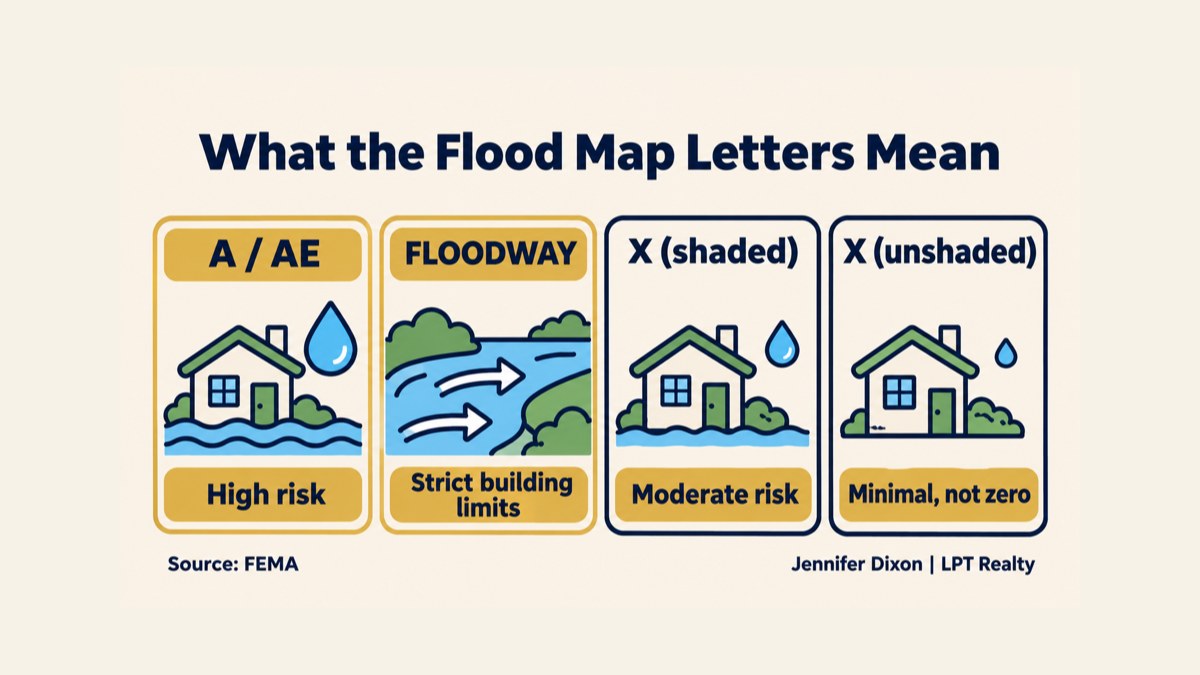
- A or AE: high risk. FEMA calls it a 1% chance of flooding every year. Sounds small, right? Over a 30-year mortgage, that's about a 1-in-4 chance. If you're using a government-backed loan, your lender is going to require flood insurance.
- Floodway: inside that high-risk zone, this is the part where the water actually moves. Chattanooga's new rules don't allow new buildings in the floodway at all.
- X (shaded): moderate risk.
- X (unshaded): minimal risk.
"Minimal risk" is not zero risk
This is my big point. That August storm flooded a lot of homes that were not in a high-risk zone. Flash flooding doesn't check the map first.
And your regular homeowners insurance does not cover flood. That's a completely separate policy.
So if the house sits near South Chickamauga Creek, Wolftever Creek out in Ooltewah, Chattanooga Creek, any creek, any low spot, or the bottom of a hill, ask more questions. Which brings me to my list.
5 things I ask before my buyers make an offer near water
- Has it ever flooded? The seller disclosure asks about flooding. Actually read it. Then ask straight out: have there been any flood insurance claims?
- Does the seller have a flood policy, and what does it cost? Some flood policies can transfer to the buyer. Ask your insurance agent whether that would save you money.
- Is there an elevation certificate? It tells you how high the house sits compared to the flood level, and it can change your insurance price.
- Get a flood insurance quote during your due diligence period. Not the week of closing. If that number blows up your budget, you want to know while you can still walk away.
- Use your eyes. Look for water lines on basement walls, a sump pump, and how the yard drains. If it rains hard while you're under contract, go drive by. I'm serious. I love looking at houses on rainy days.
One more: if you're paying cash and decide to buy flood insurance, there's usually a 30-day wait before a new policy kicks in. Don't wait until the forecast looks bad.
The investor rule that can wreck a rehab
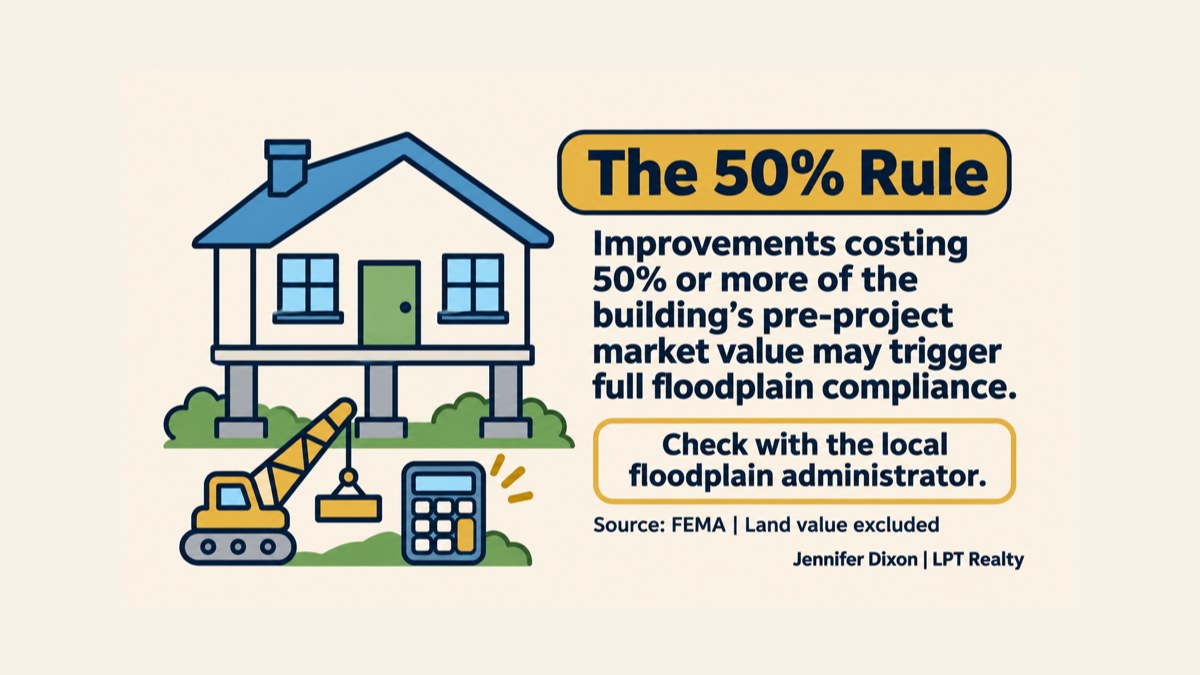
Here's the one I promised. If the house is in a high-risk flood zone and your rehab costs 50% or more of what the building is worth (not counting the land), you can be required to bring the whole house up to current flood rules. Sometimes that means raising it. That can wreck your numbers in a very big way.
I love buying ugly houses and making them beautiful. But call the city or county floodplain office before you budget the rehab, not after demo day.
And if you're looking at a cheap lot to build on, check whether it's in the floodway first. If it is, you're probably not building anything.
The takeaway
Check the address before you offer. Know your letter. And if the answer is "yes, it's in a flood zone," that doesn't automatically mean walk away. It means know the insurance number and use it.
Because if the house is in a flood zone, that insurance is part of your monthly payment, and that's leverage at the negotiating table. I broke down exactly how to use it in Chattanooga Buyers Finally Have Negotiating Power: What to Ask For (2026).
Eyeing a house right now? Send me the address before you write the offer. I'll pull the flood map and tell you exactly what I'd ask the seller. Email jennifer@southeastrealestateinvestors.com, DM me @jennsupragent, or book a call with me.
Figures current as of November 2026. Sources: National Weather Service (August 12, 2025 rainfall), Local 3 News (flood insurance coverage), City of Chattanooga and FEMA (flood map effective date, floodway rules), RISMedia (Zillow flood scores), FEMA Flood Map Service Center. This isn't insurance or legal advice. Talk to a licensed insurance agent and your local floodplain office.
Jennifer Dixon, MBA, LPT Realty
Categories
Recent Posts






Buying, selling, or investing in Chattanooga or North Georgia? I’ll help you understand your options and plan your next move.